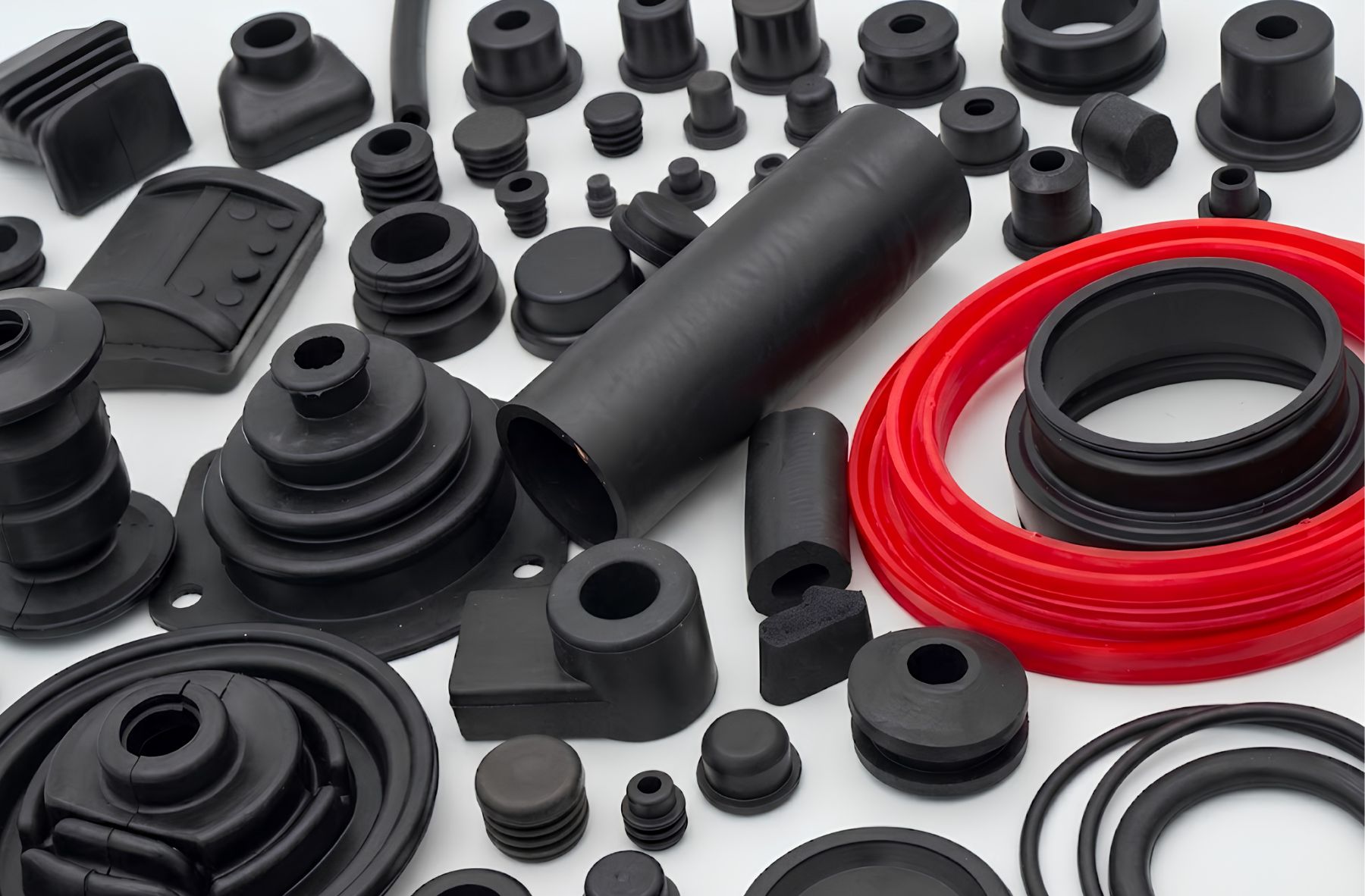
Rubber gaskets are used for many different applications, including everything from food and drug manufacturing and industrial piping to the marine, automotive and energy sectors. Used in every industry, gaskets are particularly useful for general purpose applications involving low to medium temperatures and pressures.
The versatility of rubber makes it suitable for applications even where it will come into contact with water, chemicals, oils and hydrocarbons.

What is a gasket?
Rubber gaskets are components used to mechanically seal a microscopic gap between two joints or surfaces. As a result of the rubber gasket’s elastomeric nature, it seals the surfaces by filling in the irregular surface shapes of the rigid parts.
There are many different types of rubber gasket materials. For example, EPDM gaskets have good weathering resistance, dielectric and insulating properties. They provide effective resistance to acids, alkalis, alcohol and ketone-based solvents.
What are the best materials for gaskets?
This depends on the application, as the many different types of materials for gaskets all have their own advantages.
Nitrile is known for its resistance to oils, fuels and petroleum-based solvents, while neoprene gaskets are known for their flame-retardant grades.
Renowned for its resilience, natural rubber also provides fatigue resistance, while silicone gaskets have good ozone, oxygen, heat, light and moisture resistance.
Butyl gaskets are ideal for general use because they have good abrasion, tear and thermal resistance properties. They also tend to cost less than some of their counterparts.
A high-performance material, Viton tends to be more expensive. Typically used in extreme applications, such as seals for aircraft and automotive engines, Viton gaskets operate well in high temperatures and can resist fuels, oils, acids and alkalis.
How does a gasket work?
The sealing effect is due to the rigid parts exerting compressive forces that will change the shape of the gasket.
Both natural and synthetic rubbers belong to a group of materials known as elastomers. These are types of polymers with an elastic nature that is created by cross-linking long polymer chains into amorphous structures without a clearly defined shape.
Relatively weak intermolecular forces linking the polymer chains enable them to be reconfigured when stress is applied. This means the elastomeric gaskets can conform easily to many surface profiles to create a tight seal.
The majority of rubber gaskets are limited to around 150 psi (10 bars), although some engineering-grade types, like PTFE, can reach up to 800 psi (55 bars).
What are gaskets‘ key applications?
If you’ve asked the question, “What are gaskets used for?” the answer is not easy to define, since they are utilised in just about every piece of equipment in industry, in all sectors and settings.
Widely used in the automotive, marine and aerospace industries and for drug processing equipment, food quality rubber is used for gaskets in the food and beverage manufacturing sector.
Rubber gaskets are used for applications such as sealing the flange faces of piping and fittings, the surfaces of an engine block and automotive cylinder head, door edges and frames, tank rims and covers, industrial valves and pipe joints and in utility and chemical processing lines.
What are the main types of gasket?
There are three main types of gasket: metallic, semi-metallic and non-metallic.
The gasket’s effectiveness depends on its compatibility with the adjacent materials and its ability to withstand conditions including high or low temperatures and high bolt loads. The different materials are designed to be used for each specific application, thanks to their various properties.
There are many advantages provided by rubber gaskets, but most notably, they are low cost, have excellent sealing properties and are available in a choice of any different materials, offering a wide range of physical properties. This means you can choose bespoke rubber gaskets specifically designed for your application.
From the tiniest seals and bearings to the largest motors, each application and component is equally important. This is why each gasket product that we stock has been subject to a stringent quality certification procedure before being added to our inventory, ensuring greater effectiveness and a longer product life for your equipment.
We provide high-quality rubber gaskets that are certified and tailored to your specific application, using a range of materials and bespoke cutting methods to meet all industrial requirements.