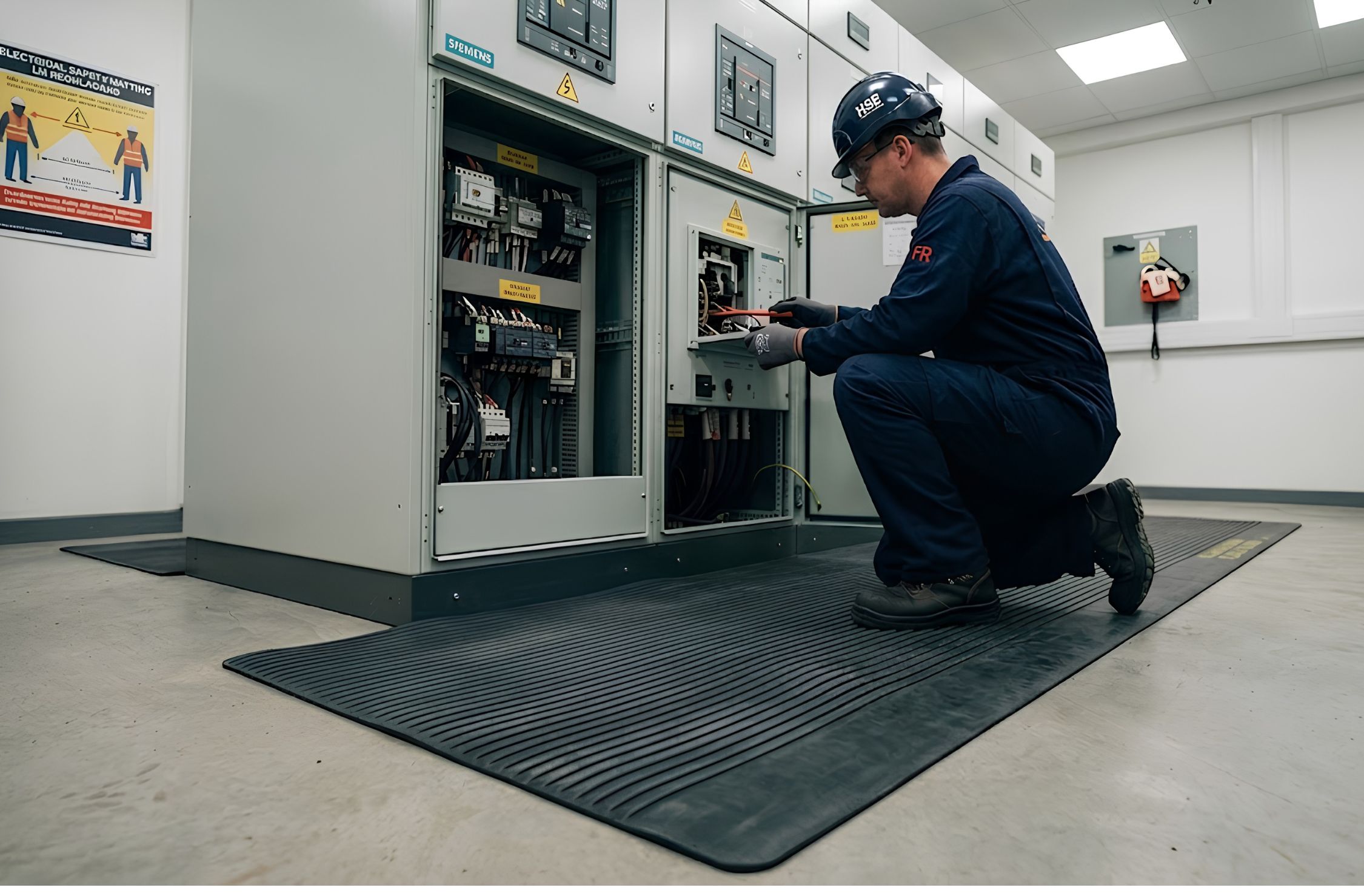
Electrical safety matting is essential, providing protection for employees against hazards such as electrocution in the workplace: people who work around various types of electrical equipment, including switchboards, can be at risk of accidents such as electric shocks, whether it’s low, medium or high voltage machinery.

© A_stockphoto / Shutterstock
Stringent safety standards, such as BS EN 61111, must be applied in the workplace if there’s even a small risk of injury through an electrical malfunction.
Every year, around 1,000 accidents in the UK involving shocks or burns are reported to watchdog the Health and Safety Executive. Tragically, this includes on average 30 fatalities, most of which occur due to contact with overhead or underground cables.
Accidents can also result if workplace electrical equipment is installed incorrectly, leading to electrocution. Non-fatal accidents can still cause life changing injuries, which is why the HSE is intent on upholding health and safety standards through rigid legislation.
How have safety standards evolved?
19th century factory workers were at constant risk of serious accidents since the early days of commercial electricity in the UK in the 1880s. It wasn’t long before safety guidelines were incorporated by the government into factory laws, following reports of fatal electrocutions mainly linked to electricity substations and generators.
The Factory Law of 1897 in the UK aimed to protect employee rights and improve working conditions, particularly in mills and factories. The UK’s first Electrical Inspector of Factories was appointed in 1902, with specific responsibility for upholding the law in relation to electrical safety.
Between July 1906 and June 1907, eight employees died as a result of electric shocks while working in steel mills. For many factory workers, high-voltage wires that had been installed carelessly threatened electrocution on a daily basis.
In the 20th century, the development of electrical insulation materials such as polyethylene and PVC provided greater protection for employees, while the increased use of glass and ceramics helped in the design of safer electrical equipment.
In many ways, the electrification of factories provided safety benefits when installed properly. Brighter electric lights replaced gas lighting, candles and oil lamps, making it easier to see potential hazards and reducing fire risks. Shafts, belts, pulleys and flywheels that previously distributed power were replaced by electricity, reducing the risks of workers’ clothing, arms and hair becoming trapped in machinery.
Electricity also permitted the factory to be completely reorganised, as operations were no longer limited to the line of the central power shaft. The machinery could be arranged to optimise the flow of materials, vastly improving productivity.
Role of factory inspectors
In 1907, Scott Ram was appointed HM Inspector of Factories, driving safety regulations forward. He reported that “rapid strides had been made” in the design of electrical plants, supply methods and new applications of electricity, with the regulations being evermore relevant.
In 1910, he produced a document explaining the safety rules, entitled Memorandum of Electrical Regulations, copies of which were sold at three pence each. In the booklet, he noted that a “good deal of work” had been done to remedy the “more obvious” defects in the workplace, such as “bare connectors” and repairs to switches and fuses.
In another report, he noted that “vast numbers” of businesses were “making use of electrical energy” and also understood the laws. Ram was the UK’s only engineering inspector until 1921, when four more inspectors joined him. It was reported that the need for more was noted in 1914, but the outbreak of World War I delayed their appointment.
Ram was made Senior Engineering Inspector and awarded the OBE for his hard work in the evolution of safety regulations before his eventual retirement in 1930.
First British Standard established
The importance of electrical rubber matting in the workplace was officially recognised in March 1976, when the first British Standard, BS921:1976, was established, although mats had been in use for safety purposes prior to this. Focusing on the use of rubber mats to provide low voltage electrical protection, this remained the legal standard for 33 years, until it was superseded by BS EN 61111:2009, which harmonised with the international standard, IEC EN 61111:2009 Live Working – Electrical Insulating Matting.
The original 1976 standard was finally withdrawn in January 2013, as the newer standard contained updated information aimed at bringing higher-quality products onto the market that would provide better protection for users. The latest electrical insulation mat standards demand additional safety testing for ozone, oil and acid, all of which are risks to matting in substations, control rooms and transformer areas. It also introduced classification by voltage resistance and rigorous testing criteria.
Carrying out risk assessments
In the business world, rubber matting electrical safety is paramount in sectors where electrical hazards are present. Even when mats are in place, it’s still essential to conduct a risk assessment to ensure employees have adequate protection, in line with HSE regulations.
Today’s manufacturing processes and materials for electrical matting have changed, with early natural rubber being replaced or enhanced with synthetic blends for improved dielectric strength, oil resistance and longevity.
Rubber is renowned for its exceptional electrical insulating properties, enabling it to stop or reduce electric currents. Coruba offers the most extensive and compliant range of electrical safety matting/switchboard matting in the UK to protect workers from electrical shocks in environments such as plant rooms, switchboards, control rooms and other places where people handle live equipment.
Penalties for non-compliance
The potential risks of employers using outdated or non-compliant electrical matting are far-reaching. Ageing or uncertified matting may have degraded insulation properties and could fail under fault conditions, leaving workers injured and employers liable for non-compliance. Penalties can include fines, prosecution and even imprisonment for those responsible in severe cases.
The HSE is empowered to issue cautions, serve notices, suspend work and prosecute businesses and individuals. Larger companies with particularly high culpability are more likely to receive higher fines, with imprisonment for directors and managers, when a serious breach is proven.
For more information on Coruba’s electrical rubber matting products, please don’t hesitate to contact us.