First documented as long ago as the 14th century, side-saddle riding was popular at a time when it was considered vulgar for women to sit astride a horse. They were expected to wear heavy ankle-length skirts and petticoats for riding, as they did every day, due to the demands of polite society.
Adopting a more ladylike position than their male counterparts proved they were chaste and had high moral standards.
© nigel baker photography / Shutterstock
It wasn’t until the early 20th century that it became socially acceptable for female riders to wear riding breeches and sit astride their horse.
In the 21st century, side-saddle riding has made a comeback, not for modesty’s sake, but because modern women have decided they like its elegance.
What is side-saddle riding?
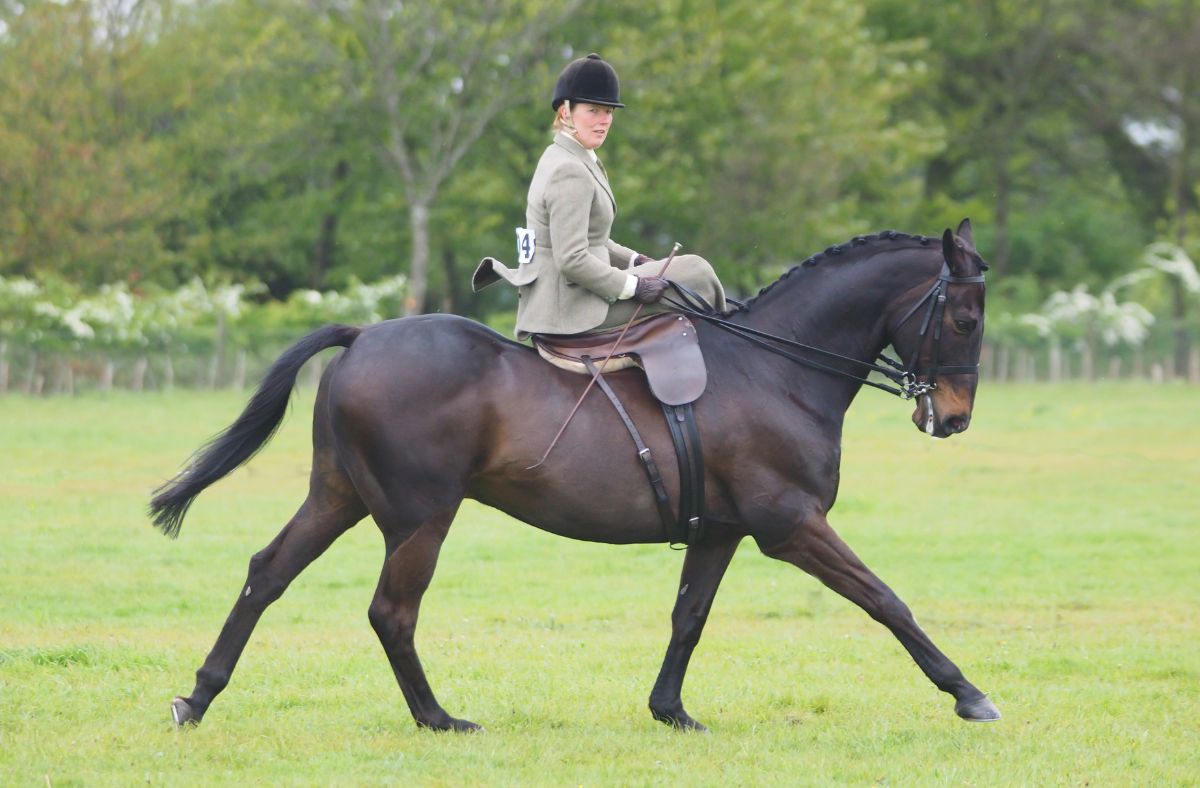
While the usual riding style involves sitting astride a horse with one leg at either side, a person riding side-saddle sits with both legs hanging down the same side of the horse’s abdomen instead.
The rider’s body must still face forward, so that the whole of their back is visible from behind. They should sit squarely on the horse, with the rider’s spine centred over the horse’s spine.
With both reins being held at the same tension and length, the rider’s hips and shoulders shouldn’t be twisted or turned off-centre. This position was quite hard to achieve in the early years, but after special saddles were developed, it became safer and more comfortable over time.
How did side-saddle riding begin?
Ordinary working-class women, including farm workers, tended to ride astride the horse, but for the upper classes, this wasn’t an option.
Historians believe side-saddle riding may have been practiced by the upper classes since time immemorial, but without written records, it’s impossible to ascertain when it began. The first documented evidence dates from 1382, when Princess Anne of Bohemia, who was also known as Anne of Luxembourg, completed the arduous journey across Europe for her wedding to King Richard II of England.
Anne, the future Queen of England, rode side-saddle for 940 miles with her entourage, arriving in time for the coronation on 22nd January 1382.
Women across Europe mastered side-saddle riding, with Anne making the style more popular among female riders in the Middle Ages.
In those days, the saddle was vastly different from today’s. It resembled a chair on which the rider sat sideways, with her feet on a footrest. It was also an era when women rode pillion behind male riders on a small, padded seat, their long, heavy skirts making it impractical to sit astride a horse.
The existing saddle design continued until the 16th century, when Catherine de Medici, the Queen of France from 1547 to 1559, created a more practical saddle.
She dispensed with the old-fashioned footrest and devised a new way of sitting, putting her right leg over the saddle’s redesigned pommel. This gave the rider more control over the horse, while enabling the rider to canter and trot safely.
Evolution of side-saddle riding
In the 1830s, a revolution occurred in side-saddle design when a second pommel was added, giving female riders the ability to ride at a gallop by reducing the risk of falling off. They could even jump fences and were able to take part in hunting and showjumping.
In the mid-19th century, horse riding and dancing were the only physical activities that were socially acceptable for women of the upper classes and aristocracy, so the new saddle design opened up greater possibilities for them.
Side-saddle for women for reasons of modesty was mainly a cultural tradition in Europe. Other cultures permitted women to ride astride a horse for practical reasons, such as in China, where women reportedly played polo wearing trousers while sitting astride their horses.
By the late 19th century, women were competing in international showjumping events, still riding side-saddle but achieving amazing feats. For example, Australian showjumper Esther Stace, aged 44, riding side-saddle on her regular horse, Emu Plains, set a new world record jump of 6ft 6ins at the Sydney Royal Easter Show of 1915. The record stood for an incredible 98 years until 1913.
20th century riding
In the early 20th century, it became more socially acceptable for women to ride astride a horse, especially during World War I, when women took on many jobs traditionally done by men.
The women’s suffrage movement said forcing women to ride side-saddle was “oppression” and staged a protest led by US activist Inez Milholland, who rode astride a horse to lead 8,000 people to Washington to demand rights for women.
The TV drama series, Downton Abbey, has been hailed as depicting the transition perfectly. During the first series, set in 1912, the leading character, Lady Mary Crawley, is seen riding side-saddle frequently and remarks her grandmother wouldn’t permit her to ride astride a horse. In the final series, set in 1925, Lady Mary is seen riding astride, much to her father’s amusement, as she adopts the modern style.
Do men ever ride side-saddle?
Side-saddle is traditionally described as being a women’s domain, but men are also known to have used the style. In years gone by, stable grooms and horse trainers were traditionally male. They would learn how to fit a side-saddle and would train the horse in readiness for lady riders.
Disabled men who were unable to use a regular saddle were sometimes able to ride side-saddle so they could still do the sport they loved.
During World War II, soldiers who were trained to lay cables often learned to ride side-saddle so they could do so while riding at a gallop. This meant it was easier to lay the cables at speed without becoming entangled in them.
Side-saddle in modern times
In the 21st century, side-saddle riding has made a comeback, aided by the UK-based Side Saddle Association, which says new riders of all ages are taking it up for pleasure, sport and competitions.
The organisation is keen to keep the ancient art alive, stating it looks “fantastic when done correctly”. Another benefit is that horses used for side-saddle events don’t need to be top showjumpers, or particularly talented. As long as the horse is well-schooled and good-mannered, it should be able to compete. Taking part in side-saddle riding can extend older horses’ competitive lives.
In modern times, far more emphasis is placed on the comfort and safety of horses than in bygone times. A clean and hygienic stable is vital to the horse’s wellbeing, which is why many riders choose rubber stable matting for added warmth and comfort. It offers multiple benefits, such as reducing the impact of a hard stable floor on horses’ limbs and joints by providing a cushioned surface, helping to prevent injuries by absorbing impact.
Mats for stables are also easier to clean than traditional flooring, reducing the need for bedding materials by up to 80% and saving money at the same time.
In the winter months in particular, rubber mats can help to insulate the stables against damp and cold, providing a healthier environment for your horse.