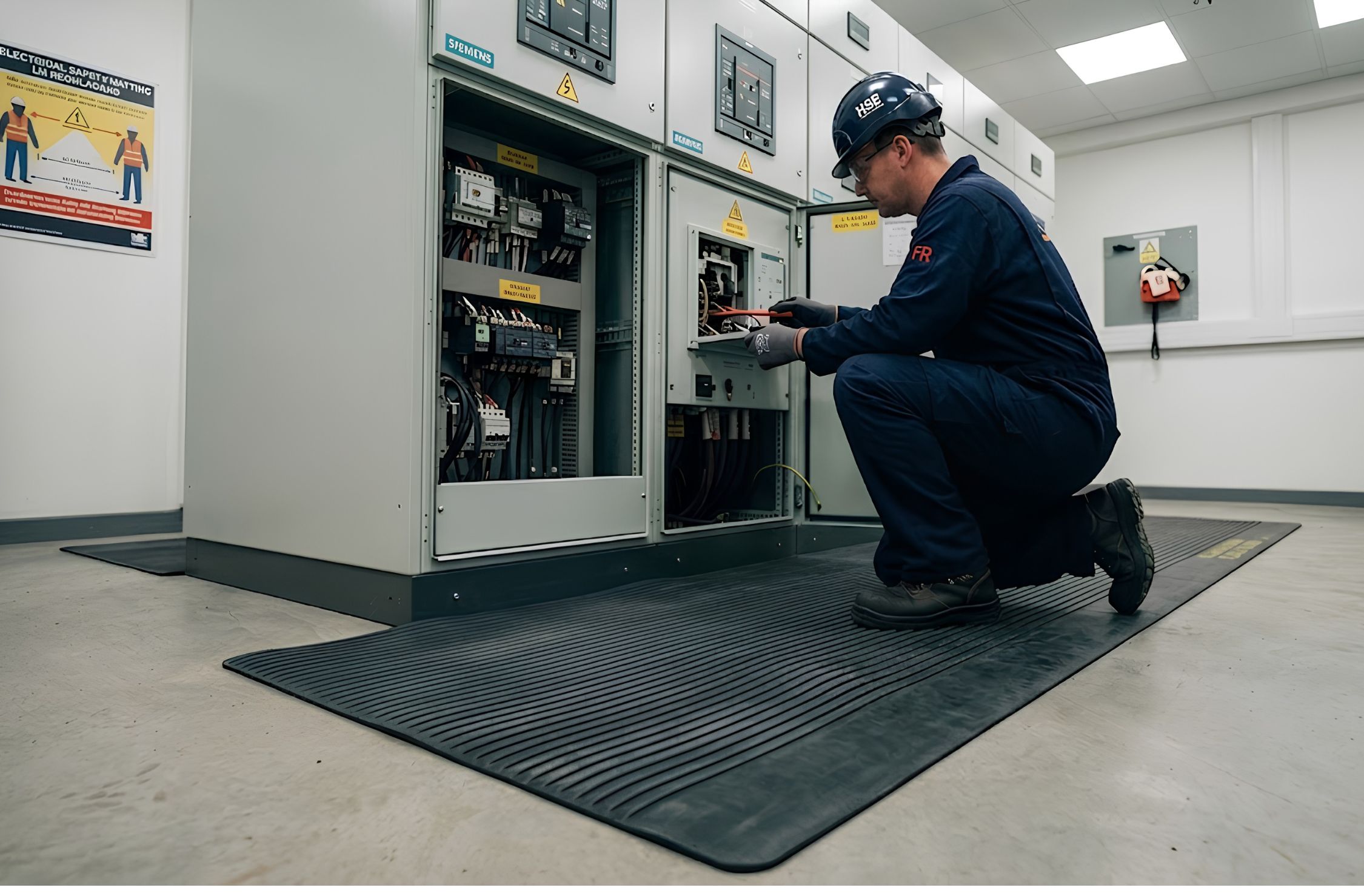
Electrical safety matting is a type of rubber floor covering that provides insulation in areas of the workplace where there’s a risk of electric shock, or where employees work around high voltage equipment.
Rubber electrical safety mats contribute to the health and safety of people working in these areas. They are much more effective than general rubber floor matting in providing the best protection.
Benefits of electrical matting
Electrical insulations are becoming more common as technology advances. The health and safety risks increase as a result.
A severe electric shock can be fatal and electrical mats have become an important industrial resource to reduce the risks.
Statistics from the Health and Safety Executive reveal there are around 1,000 accidents involving electric shocks or burns every year in the UK workplace. Sadly, this includes an average of 30 fatalities, most of which occur after contact with overhead or underground electric cables.
Electrical matting is commonly used to protect not only employees, but also the electrical infrastructure of the business. The main benefit of rubber matting is the reduced risk of dangerous electrical hazards, such as current leakage.
Installing rubber matting for electrical safety will ensure the current dissipates in the event of a leakage. This reduces the electric shock risk for any employee who is standing on the mat.
Another relevant benefit is that electrical safety rubber matting provides a softer and more comfortable surface for any employee working on electrical equipment. It contributes to workers’ wellbeing by reducing stress on their joints, especially if they are going to be standing for long periods.
What standards should electrical matting meet?
Purpose-made electrical mats are much more effective than general use rubber mats, as they are specially tested to the appropriate standards. This ensures they provide adequate protection against all electrical hazards.
Under the relevant safety standards, electrical insulating mats can also be flame-retardant, oil proof, anti-slip, alkali and acid retardant, puncture resistant and durable against marking. All these standards combine to add extra safety and health benefits to the working environment.
In the UK, electrical safety matting and switchboard matting is compliant with standards including IEC61111, ASTM D178 and BS 921. Matting that meets the IEC 61111 and ASTM D178 standards includes requirements for, among other things, oil resistance, flame resistance, low smoke and puncture resistance.
Businesses often choose matting specifically for these properties.
What electrical injuries can employees suffer?
Aside from the tragedy of a fatal electric shock, a non-fatal shock can be extremely serious, resulting in severe and permanent injuries.
Burns are among the most serious, as they can cause disfigurement and can even lead to people being unable to work ever again. Burn injuries usually occur on the hands and feet – where the current often enters and leaves the victim’s body.
An electric shock can occur if equipment or wiring are not grounded properly. When the person makes direct contact with faulty wiring and machinery, they can receive a shock of varying severity. If the equipment is incorrectly installed or insulated, this can result in fatal electrocution.
It is also common for a secondary injury to occur in the event of an electrical accident. For example, a person who suffers an electric shock while working at height can fall from a roof or ladder, causing further injuries.
The risks are not only to the people using faulty appliances: poor electrical installations can also lead to fires that can destroy business premises.
Where is electrical safety matting used?
There are various applications for electrical safety matting in industry. It has a broad use, as it can be used wherever there is risk.
Commonly used in manufacturing areas where employees are operating machinery such as engineering contractors, construction and utilities companies, it is also prevalent in the maintenance departments of public access buildings including leisure centres, shopping malls and entertainment venues.
There are many high-risk areas of the workplace where electrical matting should always be included – switchboards, power transmission rooms, lift control rooms, near high voltage panels, power plants and in front of machine control gear.
Mobile workers should also use rubber electrical matting if they are likely to come in contact with a live environment. They should be given mobile mats as part of their tools issue.
The Health and Safety Executive also states that employees carrying out welding should use electrical matting.
As an employer, if you don’t take action to protect your employees, you could be found liable if there is an accident.
Whatever the industry, it is vital to ensure all electrical installations are properly maintained. New installations must be carried out by qualified electricians to the required standards. Sufficient outlet sockets should be available to reduce the risk of overloading.
These measures, combined with electrical safety matting, will help to keep the workplace safe for all.