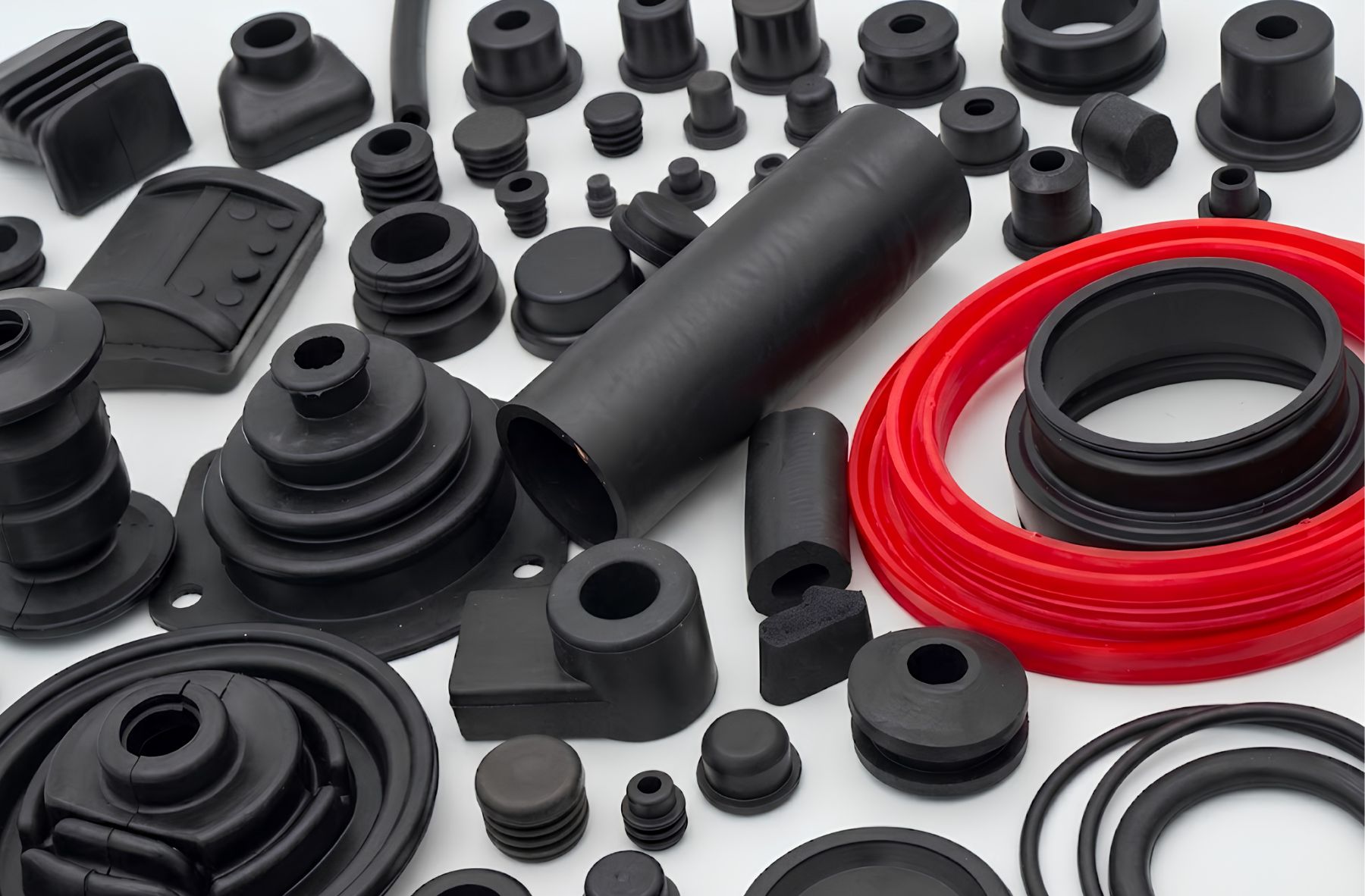
Choosing the right rubber extrusions involves considering profile geometry, dimensions, tolerances and material properties. These factors influence how the finished component fits, seals and performs in its intended application.
© Coruba
Importance of profile design
When developing extruded rubber profiles, the cross-section is designed around the component’s function. A seal may need to compress against a mating surface, while an edge trim must grip securely without damaging the connected material.
Vibration-control profiles may prioritise flexibility and resilience, whereas protective sections may require greater abrasion and impact resistance.
Profile geometry affects material flow, curing and dimensional accuracy during the rubber extrusion process. In rubber profile extrusion, wall thickness, hollow sections, lips, ribs and transitions all affect the finished profile. Balanced sections and suitable radii can help maintain dimensional consistency, while abrupt changes in thickness may make manufacturing more difficult.
Even small differences in critical dimensions can affect fit, retention or sealing force, particularly when an extrusion locates into a channel or fits over a panel.
Designing extruded rubber seals for real applications
The key consideration for extruded rubber seals is whether the profile can maintain the required contact pressure over time. Insufficient compression may leave a leakage path, while excessive compression can accelerate permanent deformation. The seal’s effectiveness also depends on its ability to maintain contact pressure throughout its intended service life.
Rubber behaves differently from rigid machined components due to its flexibility. ISO 3302-1 defines recognised dimensional classes for rubber products, allowing precision requirements to reflect the application. Greater accuracy may be unnecessary for non-critical features and can increase manufacturing costs or complexity.
Choosing the right rubber compound
EPDM is often a strong choice for outdoor applications because of its resistance to weathering, ozone and UV exposure. Standard compounds can typically operate over a broad temperature range of -40°C to 120°C for standard EPDM grades and higher temperatures for specialist formulations. EPDM is also well suited to water, steam and many chemical environments. It can be limited due to poor resistance to petroleum-based oils and hydrocarbons.
Nitrile rubber, or NBR, is often considered when contact with oils and fuels is central to the application. It offers good resistance to petroleum-based fluids and is widely used in automotive and industrial sealing applications. However, its resistance to outdoor weathering is generally lower than EPDM, depending on the compound formulation.
Neoprene, or chloroprene rubber, offers a useful balance of mechanical properties, weather resistance and moderate resistance to oils and chemicals. It can be suitable where an application requires a combination of environmental and mechanical performance rather than exceptional protection in one area.
Silicone is particularly useful for applications requiring flexibility across a wide operating range, including sealing and automotive components. Suitable for demanding environments, it also offers good resistance to weathering and retains its flexibility over extended periods.
For more aggressive temperature, fuel or chemical requirements, FKM is another option.
Standard profiles or a custom extrusion?
Standard extruded rubber profiles are often the most practical starting point. There are many established sections available for common sealing, edging, glazing, protection and retention applications. Choosing an existing profile can avoid the need for new tooling. However, a standard profile is not always the best option.
A custom section may be needed where existing designs cannot provide the required sealing compression, grip, installation method or available space. It can also be useful when several functions need to be combined into one component.
Coruba can supply standard and bespoke profiles to suit different applications. For high-volume production, the tooling cost may be justified if a tailored design improves performance, installation or material efficiency. For smaller runs, an existing profile may be more economical.
What information goes into an extrusion specification?
Start with the critical profile dimensions, required hardness (usually Shore A for solid rubber) and compound, if known. Specify the operating temperature and exposure to oils, fuels, water, cleaning chemicals, steam, UV, ozone and abrasion. Include whether the profile is static or moving, how frequently it will be compressed or flexed, and whether pressure, vacuum or vibration is involved.
For seals, specify the mating gap, installation space, compression direction and expected movement. Include the substrate thickness and required grip range for retained or self-grip profiles.
Finally, state the required dimensional tolerances and any relevant standards or certification requirements. A physical sample, CAD model or technical drawing can be particularly useful when replacing or improving an existing component. This will help us better understand the requirements for a bespoke extrusion.