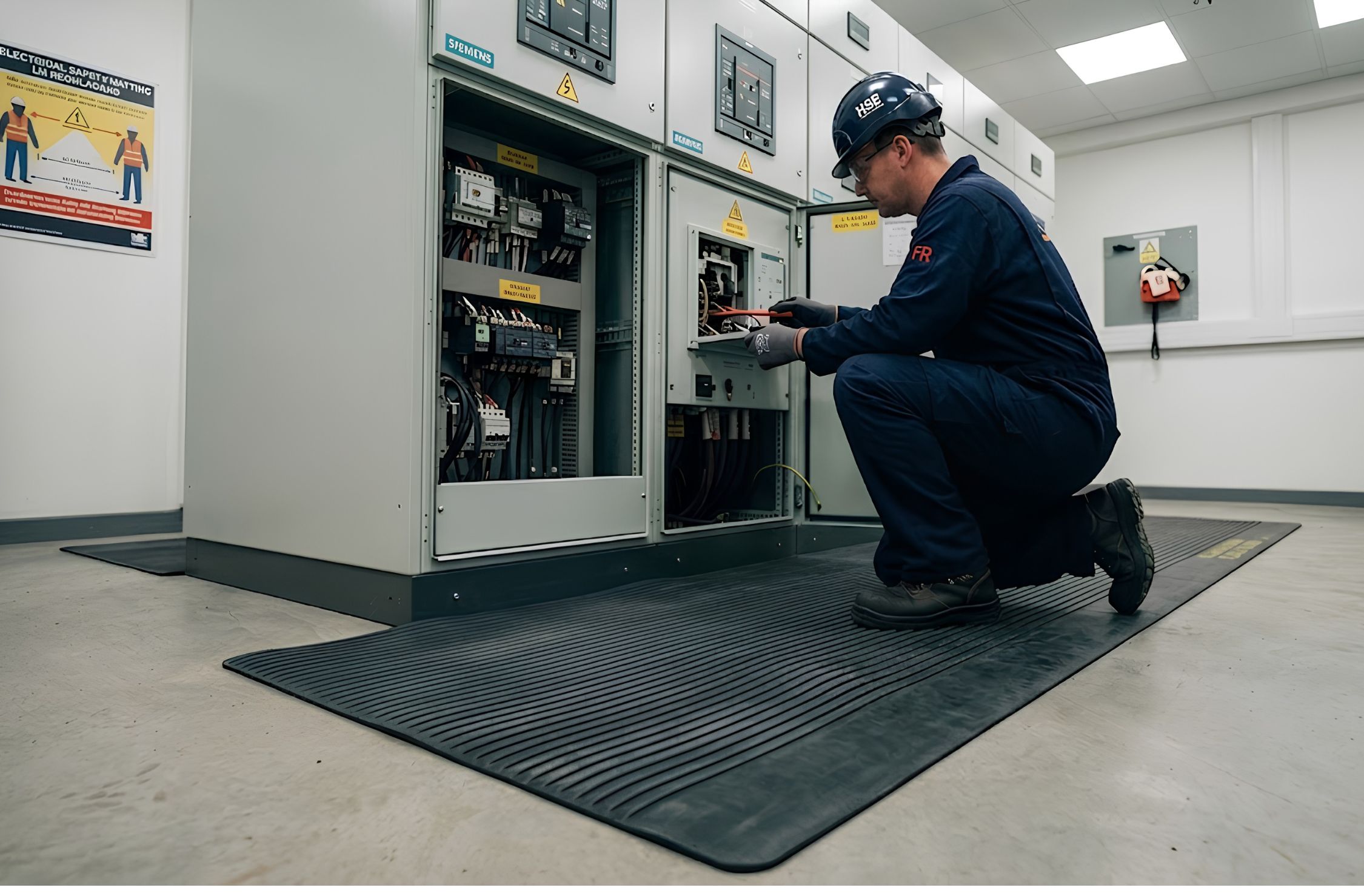
When electrical work takes place around exposed or potentially live equipment, the floor beneath the worker is an important part of the safety picture. A suitable insulating mat can provide an additional barrier against electrical shock.
Rubber matting electrical safety isn’t simply a case of putting a heavy-duty rubber floor covering in front of a switchboard: the mat needs to be appropriate for the electrical environment, correctly specified for the voltage involved and maintained in a condition where its insulating properties can be relied upon.
 © AI
© AI
For UK workplaces, the key technical reference is IEC 61111, adopted in the UK as BS EN 61111:2009. This is a standard rather than legislation. Legal duties arise primarily from the Electricity at Work Regulations 1989, while BS EN 61111 sets out requirements for insulating matting.
HSE guidance HSG85 also identifies insulating matting to BS EN 61111:2009 as a protective measure when controlling electrical risks.
What is electrical safety matting?
Commonly installed in areas where electrical equipment is operated, maintained or accessed by personnel; electrical matting is a specialist insulating material made from elastomer materials and designed for use around electrical equipment where workers may be exposed to electrical hazards.
Typical applications include switch rooms, substations, motor control centres, generator rooms, transformer bays, testing areas, maintenance locations and areas around control panels and distribution boards.
Electrical matting should be used as part of a wider approach to controlling electrical risks rather than as a standalone precaution.
IEC 61111 classes explained
One of the most important factors when specifying electrical safety matting is choosing the correct class. IEC 61111 divides insulating matting into five classes, from Class 0 to 4, with each one associated with a maximum working voltage.
- Class 0 is rated for up to 1,000V AC or 1,500V DC, with a 5,000V proof test voltage. It’s commonly associated with low voltage switchboards, distribution boards and control panels.
- Class 1 covers up to 7,500V AC or 11,250V DC and has a 10,000V proof test voltage. It can be used around medium voltage switchgear and industrial plant rooms.
- Class 2 is rated up to 17,000V AC or 25,500V DC, with a 20,000V proof test voltage, making it particularly relevant to installations such as 11kV substations.
- Class 3 extends protection to 26,500V AC or 39,750V DC, with a 30,000V proof test voltage. Typical applications include higher-voltage substations and utility switch rooms.
- Class 4 is rated up to 36,000V AC or 54,000V DC and has a 40,000V proof test voltage. It is intended for demanding high voltage environments, including certain 33kV utility installations.
The important point is that class should be selected according to the electrical hazard, rather than simply choosing a mat because it is thicker, heavier or marketed as “industrial”.
How do the Electricity at Work Regulations apply?
The Electricity at Work Regulations 1989 place duties on those responsible for electrical systems to ensure they are constructed, maintained and used in a way that prevents danger “so far as reasonably practicable”.
Regulation 4 is particularly important because it deals with the use and maintenance of electrical systems. Regulation 14 addresses working on, or near, exposed live conductors and sets strict conditions for when work can take place. HSE guidance states live working should generally be avoided unless the circumstances justify it and suitable precautions have been taken.
The regulations establish the legal duties, while BS EN 61111 provides the technical requirements for insulating matting that can support compliance with those duties. Electrical rubber matting regulations are best understood as a combination of legal duties, technical standards and good engineering practice, rather than a single regulation specifically covering electrical matting.
Choosing the right mat for the application
This involves more than matching a product to the system voltage. The electrical hazard, surrounding environment and expected conditions of use should all be assessed before specifying the correct matting. Identify the highest voltage that workers could reasonably be exposed to, including relevant testing conditions and foreseeable fault scenarios. The guidance also recommends considering future equipment changes, rather than specifying purely around today’s installation.
Consider the environment. Moisture, oil, chemicals, temperature, ultraviolet exposure, foot traffic and mechanical wear can all affect the condition of rubber. A mat that is electrically suitable in theory may not remain efficient if installed in an environment that accelerates deterioration. The rubber compound and relevant resistance characteristics should therefore be checked against the actual conditions of use, particularly in industrial, outdoor or semi-exposed environments.
Compliant matting should have permanent identification showing details such as its class, standard reference, manufacturer identification and year of manufacture.
Inspection, testing and maintenance
Routine inspections should look for cuts, punctures, cracking, hardening, deformation, excessive wear and contamination. Oil, chemicals, dirt and moisture can affect the condition of the rubber, particularly in demanding environments.
Visual checks should be documented, with periodic electrical testing carried out at appropriate intervals based on the conditions of use. If matting is damaged or its condition is uncertain, it should be removed from service and assessed before being used again.
Electrical matting as part of a wider safety system
As part of a wider electrical safety strategy, insulating matting should be used alongside other appropriate precautions. HSE’s HSG85 guidance specifically discusses insulating matting in this context. Correct isolation and lock-off procedures, competent employees, suitable insulated equipment, risk assessment, appropriate PPE and effective working practices remain essential. For UK businesses, electrical matting should therefore be considered as part of a wider electrical safety strategy, with its suitability, condition and use reviewed as part of the overall risk assessment.
Correctly specified, maintained and used alongside appropriate safety controls, rubber electrical matting can provide an important insulating barrier around electrical equipment.