Three main classifications of gasket materials are used for a wide range of different applications: these are metallic, semi-metallic and non-metallic.
A gasket’s effectiveness depends on several factors, including its compatibility to the adjacent material and its ability to withstand conditions such as high temperatures and high bolt loads. Different materials are used for their manufacture to ensure they are suitable for each specific application.

What is a gasket?
A gasket seals the gap between two surfaces, preventing leaks from a mechanical joint and strengthening its weak point.
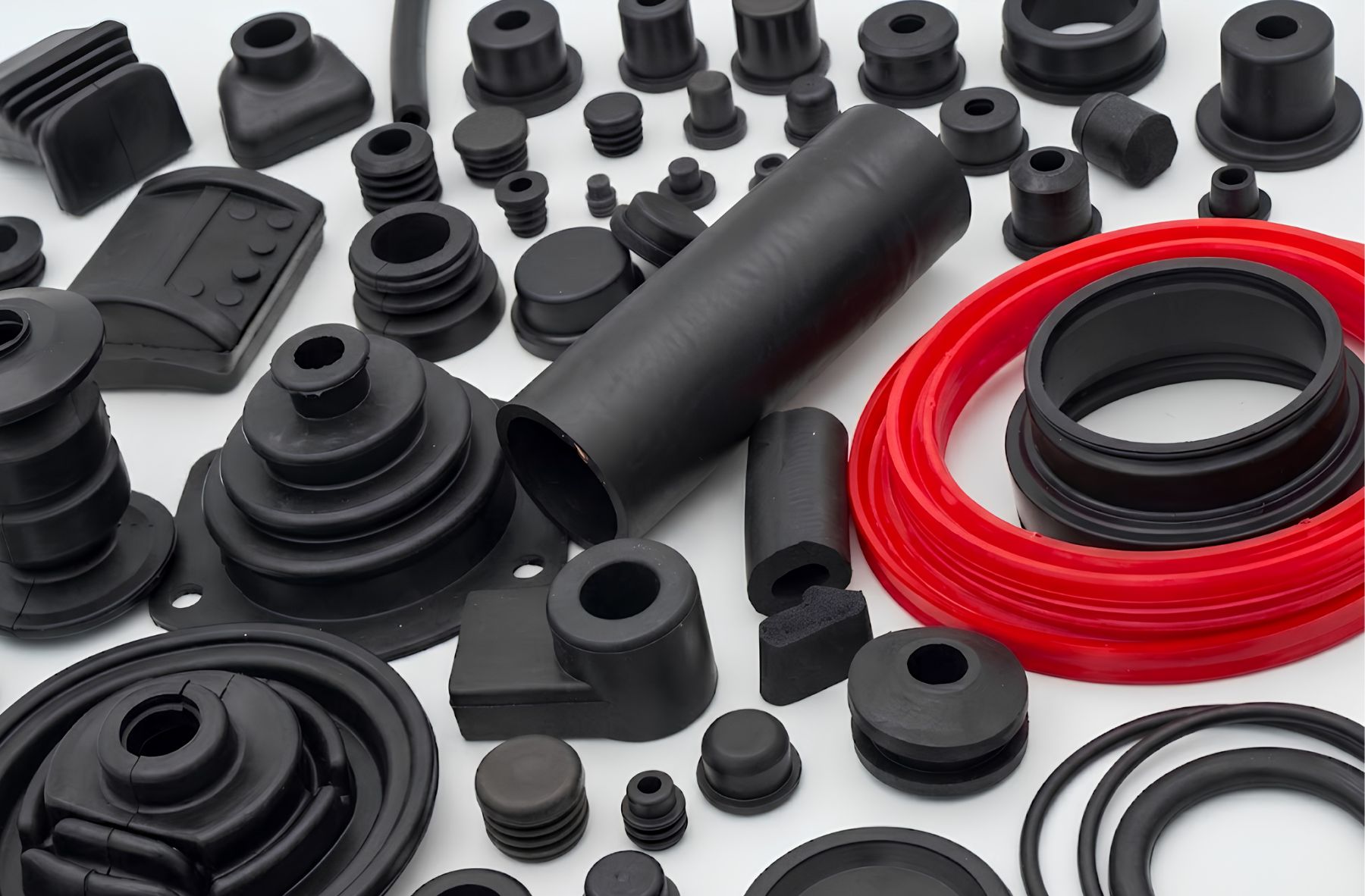
In the majority of cases, rubber gaskets are used. They are produced in many different shapes and sizes, depending on their application.
- Metallic gaskets
Metallic gaskets are manufactured from one metal, or by combining several metals. Suitable for applications that require high bolt loads and temperatures: an example is the corrugated metal gasket, which has parallel grooves and ridges to increase its strength. This type of gasket has a high resistance level.
Metallic ring joints are often used for piping systems and vessels where the required pressure is around 1,000 to 15,000 psi. This gasket normally comes in an octagonal or oval shape for a better surface finish and more accurate dimensions.
- Semi-metallic gaskets
Suitable for moderately high temperature applications, semi-metallic gaskets are made from a mixture of metallic and non-metallic components.
A metal jacketed gasket is made from a metal outer shell with a non-metallic inner filler, although the filler can also be metallic if required. It is often used as a heat exchanger, transferring heat from one medium to another, as it connects two pieces of mechanical equipment together.
A cam profile gasket (normally used in industrial power plants) comprises a steel core with concentric grooves on the side.
A spiral wound gasket comprises an inner ring manufactured from special steel with a V-shaped, spiral-wound, metal strip. It is suitable for use in extreme conditions, as it can operate at a temperature of between -250ᵒC and 1,000ᵒC.
- Non-metallic gaskets
Non-metallic gaskets are normally used for low to medium pressure applications. The most common type is the rubber gasket, as it is tough, flexible and provides excellent resistance. Many types of top-quality rubber gaskets are available from Coruba – please contact our team for orders and enquiries.
Other types of non-metallic gaskets include graphite gaskets, made from either pure expanded granite, or expanded granite reinforced with metal. Pressure-based on the reinforcement, graphite gaskets are suitable for use in extreme temperatures ranging from -240ᵒC to 550ᵒC.
The PTFE or polytetrafluoroethylene gasket offers an extremely dense sealing material that will adapt perfectly to the flange. It is commonly used for materials where aggressive chemicals are present.
Gasket types vary greatly, and it is crucial that you choose the perfect solution to ensure the efficiency and effectiveness of the application.
Coruba’s bespoke gaskets
Rubber gaskets are widely used in manufacturing and engineering processes in a range of industries such as food processing, automotive, water, energy and more.
We offer a range of bespoke rubber gaskets that are available in a selection of rubber compounds. Our experts have extensive industry experience and knowledge of our craft, making us the perfect choice for your custom projects.
2D gaskets and seals are made of sheeting, using a custom-cut design, based on requirements. If you are looking for a 3D product using bespoke moulds, please visit our rubber mouldings page.
For more information on materials, please refer to our compounds list and chemical compatibility and resistance chart.