Conveyor belts are much more than the moving strips we see in supermarkets, airports and factories. Their evolution from basic wooden and leather systems to the high-strength rubber and steel belts of the 21st century is fascinating.
The earliest conveyor belts comprised a flat wooden bed with a simple strap of leather or canvas running over it. Aimed at reducing human labour and increasing operational efficiency, they included a belt conveyor, bucket elevators and Archimedean screws. Operated by hand, they relied on basic mechanical components, such as cranks and pulleys, to move flour, grain, or similar goods in milling, agricultural and shipping operations.
© Penny Hicks / Shutterstock
Key inventors who shaped the history of conveyor belts
No individual is credited with inventing the conveyor belt, although historians have traced its design back to the 18th century. One early example was American mechanic Oliver Evans’ belt made for an automated flour mill in around 1790.
By the mid‑1800s, innovators had started experimenting with steam‑powered belt systems and working on linked metal belts and drive‐chains. William Dana Ewart invented linked belts in 1874 for agricultural use.
Several inventors played major roles, such as Thomas Robins Jnr. In the early 1890s, he developed heavy‐duty conveyor belts capable of carrying coal, ore and similarly abrasive materials. His designs used rubber‑covered belts with steel idler rollers underneath to bear the load and reduce friction. His conveyors won recognition at world fairs, such as the Paris Exposition.
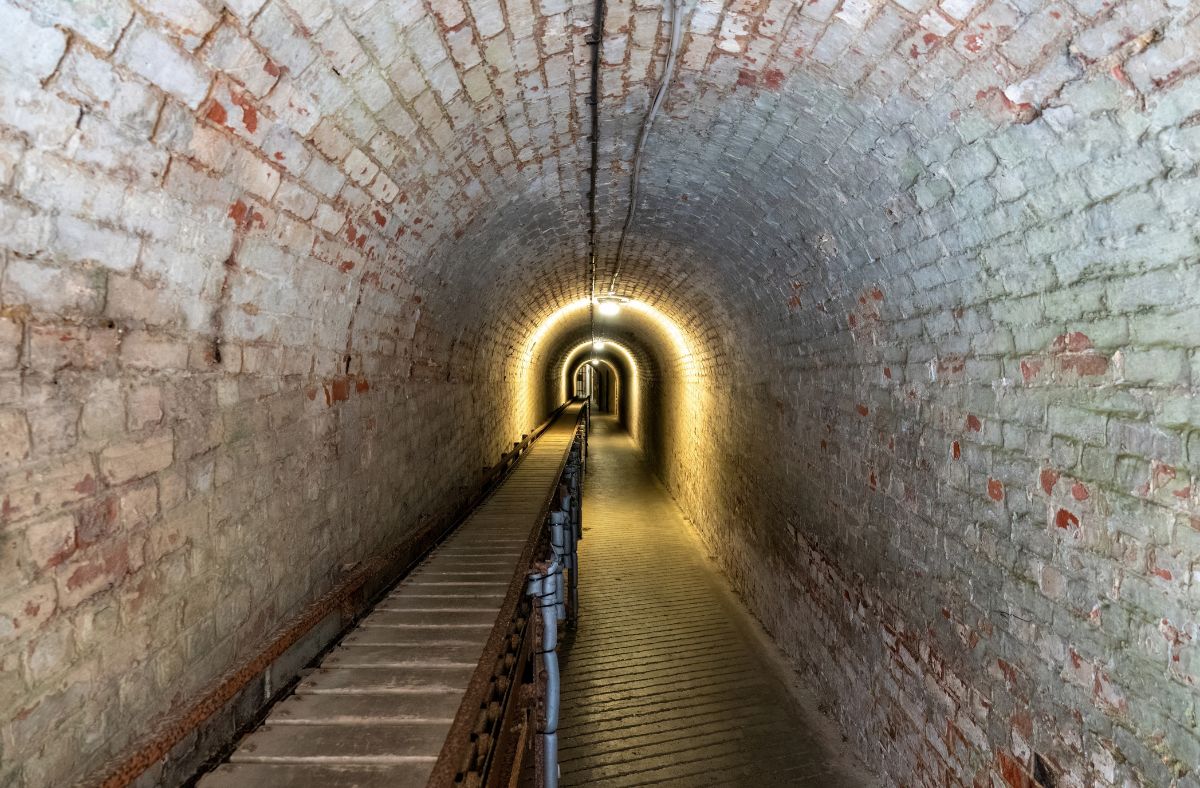
Another key figure, British engineer Richard Sutcliffe, adapted belt conveyor technology for use underground in mines in 1905. Putting belt systems underground meant dealing with difficult conditions such as moisture, abrasion and confined spaces. Sutcliffe’s company, Universal Works, transformed heavy industry with underground conveyor systems.
Impact of the Industrial Revolution
Conveyor belt technology evolved rapidly, as factories needed to move large volumes of raw materials, parts and goods from one stage of production to another. Manual carrying or using simple rail carts was inefficient, costly and slow. Conveyor belts enabled continuous movement of materials, which meant faster throughput and less manual labour.
Steam power was a staple in the Industrial Revolution, allowing for much larger, heavier and more durable belts. At the same time, iron, steel and better machinery meant rollers, pulleys, frames and supports could endure more stress.
Factories and mines needed materials that could resist wear, heat and moisture, with the Industrial Revolution setting in motion a chain of innovation in both the belts’ structure and materials. Early examples made of leather, canvas or untreated natural cloth were prone to rotting, stretching and wear, as well as being vulnerable to environmental factors. Rubber proved to be a game changer. Charles Goodyear’s invention of vulcanised rubber in 1844 greatly increased the durability and heat resistance of conveyor belts, which could handle harsher loads and more abrasion.
Later, as industrial needs diversified, additional materials were introduced. Steel belts were used for high-strength, high-durability applications. Synthetic fabrics such as polyester, nylon and aramid began to replace natural fibres for their resistance to stretching, ability to support heavy loads and better performance in moisture or harsh chemical environments.
Innovations such as rubber cleats, side‑walls, top covers to protect the goods and bottom covers over the support rollers improved the design. Various plies in the belt carcass, such as multiple layers for tensile strength, and better splicing techniques have all contributed to greater longevity, better safety and more efficient operation.
Mining was most transformed by conveyor belts, as those adapted for underground use made the continuous removal of materials feasible, reducing bottlenecks, improving safety and lowering costs. Heavy industries such as steel, cement, chemical, aggregate, quarrying and ore processing also benefited when conveyors grew longer, stronger and more reliable. The ability to automate parts of these processes moved large quantities cheaply and reduced human fatigue, which was hugely important in scaling up industry.
Henry Ford’s assembly line
In 1913, Henry Ford implemented the first moving assembly line using conveyor belts in his Highland Park automobile factory in Michigan. Although conveyor belts were not his invention, he recognised their potential. He adapted the conveyor into his assembly line so that car parts continually moved past workers, who each performed specific tasks.
This flow improved production time dramatically. It cut the time taken to assemble a Model‑T from roughly 12 hours to about one hour and 33 minutes, which was astounding. Once other manufacturers saw the efficiency gains, many industries moved to replicate or adapt the same principles in other areas. Conveyors became central to the mass production of consumer goods, electronics, food and packaged items.
The assembly line was a turning point, transforming conveyor belts from material handling in heavy industry towards general manufacturing, packaging and processing.
Evolution of materials and designs
After natural materials such as leather, canvas and untreated fibres came vulcanised rubber, followed by steel and synthetics. TPU, PVC, polyester, nylon and aramid brought new advantages: lighter weight, greater tensile strength and better resistance to temperature, chemicals, moisture and abrasion.
In design terms, there are many different types such as flat, modular plastic, or steel cord belts; side‑wall and chevron belts for incline work; belts for food hygiene and easy cleaning; designs with cleats; custom surface patterns for grip or non‑slip; and those built for flame retardancy, oil resistance and other harsh conditions.
Modern conveyor belt systems also incorporate smart designs such as better rollers, improved drive pulleys and power efficiencies. Maintenance, safety, modularity and hygiene are now central concerns in many sectors.
Conveyor belt manufacturing today
Here at Coruba, we draw on the deep history of conveyor belt manufacture to provide systems that are reliable, safe, efficient and suited to the very specific demands of today’s industrial world. A UK manufacturer known for our industrial rubber belting solutions, we offer a variety of grades, from light- to heavy-duty. These come with different plies, cover thicknesses and materials, depending on the application.
Our stock includes major qualities used throughout industry, and we provide both full‑width rolls and slit‑to‑width options for custom needs. We support industries with belts that are abrasion resistant; heat, oil and grease resistant; and for certain applications food grade. As a modern conveyor belt manufacturer, we bring together traditional rubber technology, robust structure, materials science and bespoke design.
Today’s materials allow conveyors to be longer, stronger and more reliable. Smart designs are optimised with sensors, automation and predictive maintenance. Energy efficiency is increasingly important. Lighter materials, better designs, lower friction rollers and power‑efficient motors help reduce energy costs. Making belts with longevity, designing splices that last and reusing or recycling worn belts where possible is crucial to sustainability.
The journey of a conveyor belt, from simple wooden frames and leather straps to today’s complex systems of bespoke engineering, reflects centuries of trial and error, experimentation and ultimately success.