How Anti-Fatigue Mats Work
The cushioned surface encourages small, natural movements in the legs and feet. These micro-movements stimulate blood flow, reducing the muscle fatigue that builds up during long periods of static standing on hard floors. Independent research, including studies from Loughborough University, has linked this kind of matting to measurable improvements in standing comfort and reduced musculoskeletal strain — which is why anti-fatigue matting is now standard practice across manufacturing, retail, and hospitality environments where staff spend long shifts on their feet.
Anti-fatigue mats also distribute body weight more evenly, reduce impact on joints, and insulate against cold concrete. In wet or oily environments, specialist drainage and oil-resistant surfaces improve grip and reduce slip risk, helping support safer, more comfortable working conditions.
Key Benefits of Anti-Fatigue Matting
- Reduces fatigue caused by prolonged standing
- Alleviates strain on feet, knees, and lower back
- Improved comfort and circulation during long shifts
- Better grip and slip resistance in wet or oily conditions
- Added insulation from cold concrete floors
- Improves focus across the working day
Types of Anti-Fatigue Mats
- Rubber anti-fatigue mats: durable, long-lasting, and slip-resistant, this solution is ideal for high-traffic warehouse and factory floors
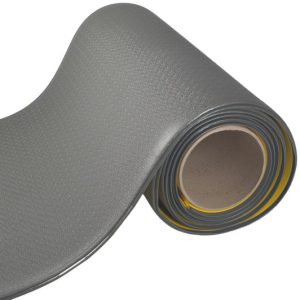
- Foam anti-fatigue mats: lightweight and highly cushioned, these are perfect for dry workstations, packing areas, and retail counters where underfoot comfort is a priority
- Oil-resistant mats: designed for oily, greasy, or chemical-exposed environments where standard rubber would degrade over time — nitrile-based materials generally hold up better than natural rubber in these conditions
- Drainage mats: open-grid designs allow liquids and debris to pass through, keeping wet areas safer underfoot. Commonly used in food processing, commercial kitchens, and wet production environments.
- Interlocking mats: these modular tiles can be expanded, replaced, or reconfigured without cutting, making them ideal for larger spaces and layouts that may change over time
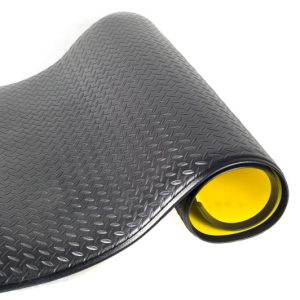
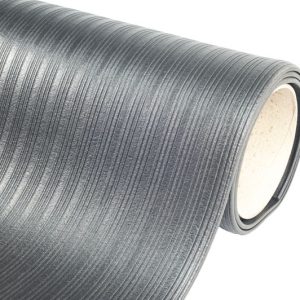
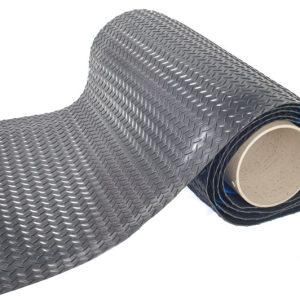
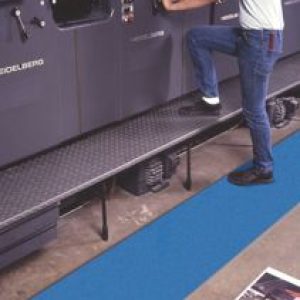
- Roll matting: continuous anti-fatigue matting, suited to production lines and areas requiring full length coverage without joins
Choosing the Right Anti-Fatigue Matting
- Environment: dry workstations suit foam or closed-cell rubber mats. Wet areas need drainage mats with an open grid to dissipate liquid. Oily or chemical environments require oil-resistant rubber mats that perform better than standard rubber over time.
- Thickness: for prolonged periods of standing, thicker mats give greater cushioning — but thicker isn’t automatically better. Beyond a certain point, a mat becomes too soft to stand on safely, creating instability rather than comfort, particularly in areas where workers are turning or carrying loads. The right thickness is a balance between cushioning and stability rather than simply choosing the deepest option available.
- Traffic and wheeled equipment: in areas where trolleys or pallet trucks operate, choose thinner, firmer industrial mats designed to withstand wheeled loads. Softer, thicker anti-fatigue mats intended for foot traffic may compress, shift, or wear more quickly under heavy rolling equipment.
- Coverage area: single mats work well for fixed workstations. Roll matting or interlocking tiles are the better choice for larger areas, production lines, or spaces with irregular layouts.
- Quality and compliance: as a UK manufacturer working to ISO 9001 quality standards, our matting is produced and tested to consistent specifications, so performance doesn’t vary between batches or over repeat orders. Our materials are also REACH compliant, giving added peace of mind for sites with strict procurement or chemical safety requirements.
Need Advice?
Call our experts on 01702 560194 for a tailored recommendation.