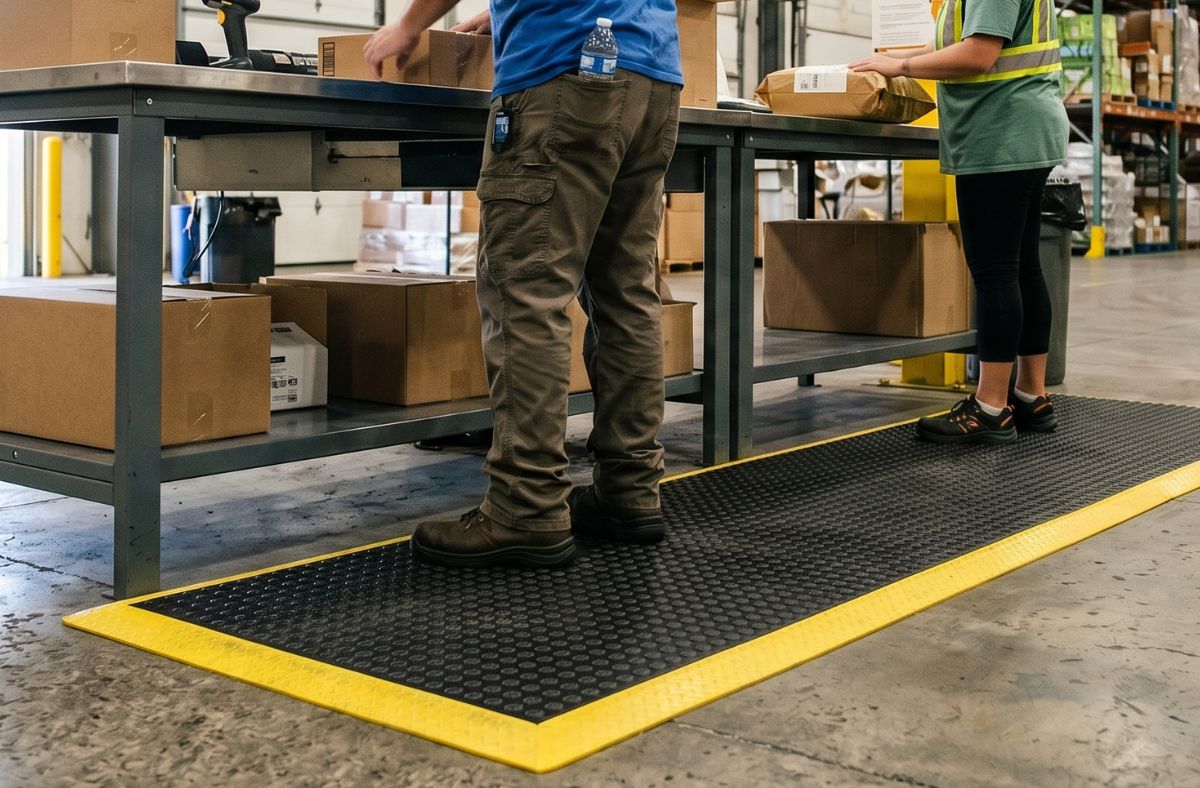
Anti-fatigue matting has many uses, from providing comfort for employees who stand for a long time in the workplace, to lighter-duty applications around the home.
When you’re working on a hard surface such as ceramic tiles, standing for even one hour can be gruelling and cause aches and pains. You don’t have to work in an industrial setting to suffer discomfort.
Anti-fatigue mats benefit people who spend hours standing at a workstation, in the kitchen or anywhere else that causes stress on the body, legs and feet.

How to choose anti-fatigue matting
The purpose of the mats is the number one factor to consider. When employees spend long periods standing up, you may have noticed people taking sick leave, or mentioning health concerns, due to the nature of their job. This is one of the main reasons to install a mat with anti-fatigue properties.
To choose the best anti-fatigue matting, you must have a clear idea of what you require it to do. Once you fully understand its purpose, narrow down your search by choosing the right mat for the specific application.
Another factor is to make your work environment safer by choosing matting with anti-slip properties.
Other considerations that should be taken into account are the size and thickness of the matting, the intensity of use and any special requirements, such as drainage, for example.
Rubber mats are vital for specialised workplace environments where employees are working with potentially dangerous liquids or materials. These areas put staff at a higher risk of accidents, including slipping. For these environments, look out for mats with anti-slip and protective properties.
Industrial anti-fatigue mats
Industrial anti-fatigue mats are used for many applications such as in wet areas, greasy and oily areas, workplaces where industrial chemicals and oils are used, and factories or workshops where sparks, flames and high heat are a risk.
Some businesses, including manufacturing plants, require more physical labour than others. It’s a good idea to install anti-fatigue matting to prevent injuries and pain.
The mats can be installed both for workers on the assembly line and at individual workstations. Determining the environment where your anti-fatigue mats will be placed is a crucial part of the buying process.
Factories, warehouses, shops and pharmacies can all enable employees to experience the anti-fatigue mat benefits that will make their job less gruelling.
Common uses for anti-fatigue mats
Any business or workspace that uses liquids and has wet work areas as a result can benefit from anti-fatigue mats with anti-slip properties. An example of this is a locker room, where employees are often expected to stand in areas that are wet, such as near the shower block, or in a public swimming pool.
Greasy areas where employees deal with food have their own anti-fatigue kitchen mats, not only to help tired legs, but also to avoid slipping if something is spilled on the floor. Using the right type of mat is important because this type of environment can soon damage mats that aren’t specifically designed for food preparation areas.
Oily areas in machine shops, or in the automotive industry, will require anti-fatigue mats with anti-slip properties. Any employees working in this type of environment would also benefit from using drainage mats that don’t deteriorate after being in contact with non-food related oils.
If the workplace environment contains industrial chemicals and oils, such as in manufacturing facilities, the employer should consider a solution that can withstand the corroding effect such chemicals can have if there’s a spillage.
In areas of high heat, where there may be flying sparks, such as in a welding shop, it’s important to install matting that can withstand sparks, and potentially flames.
Intensity of use
There’s a whole range of anti-fatigue mats, from light to heavy-duty, that can handle each different use. Choosing the wrong option will cause wear and tear. This could damage the matting, making it less effective.
However, if you purchase heavy-duty matting when you don’t actually need it, you’re spending more money without good reason.
Light-duty mats are designed for only a couple of hours’ use per day. Medium-duty mats are aimed at people who work four to six hours a day, while the sturdiest heavy-duty mats can handle two or three work shifts each day, when they are almost constantly in use.
Anti-fatigue mat sizes and materials
Once you’ve chosen the appropriate solution, determine how much you need and the most suitable format for your workspace. Choose matting in either linear metre or a modular format.
Anti-fatigue mats for walkways or assembly lines will most suit a linear solution. For individual workstations, choose a linear metre or a roll format.
If your work area has a more customised layout, a modular system enables you to fit and rearrange your floor mats in a way that will best fit the space.
General-purpose rubber is a durable, solid and slip-resistant material, which is suitable for various workplace environments. Nitrile rubber, which is synthetic, can provide stability in work environments where grease, oil, animal fats and chemicals create hazards.
Vinyl is suitable for dry applications, as it will help prevent floor damage, while providing support for employees who are on their feet for long hours.
If you’re in any doubt about what type of mat is needed, chat to an expert first to ensure you make the right choice.